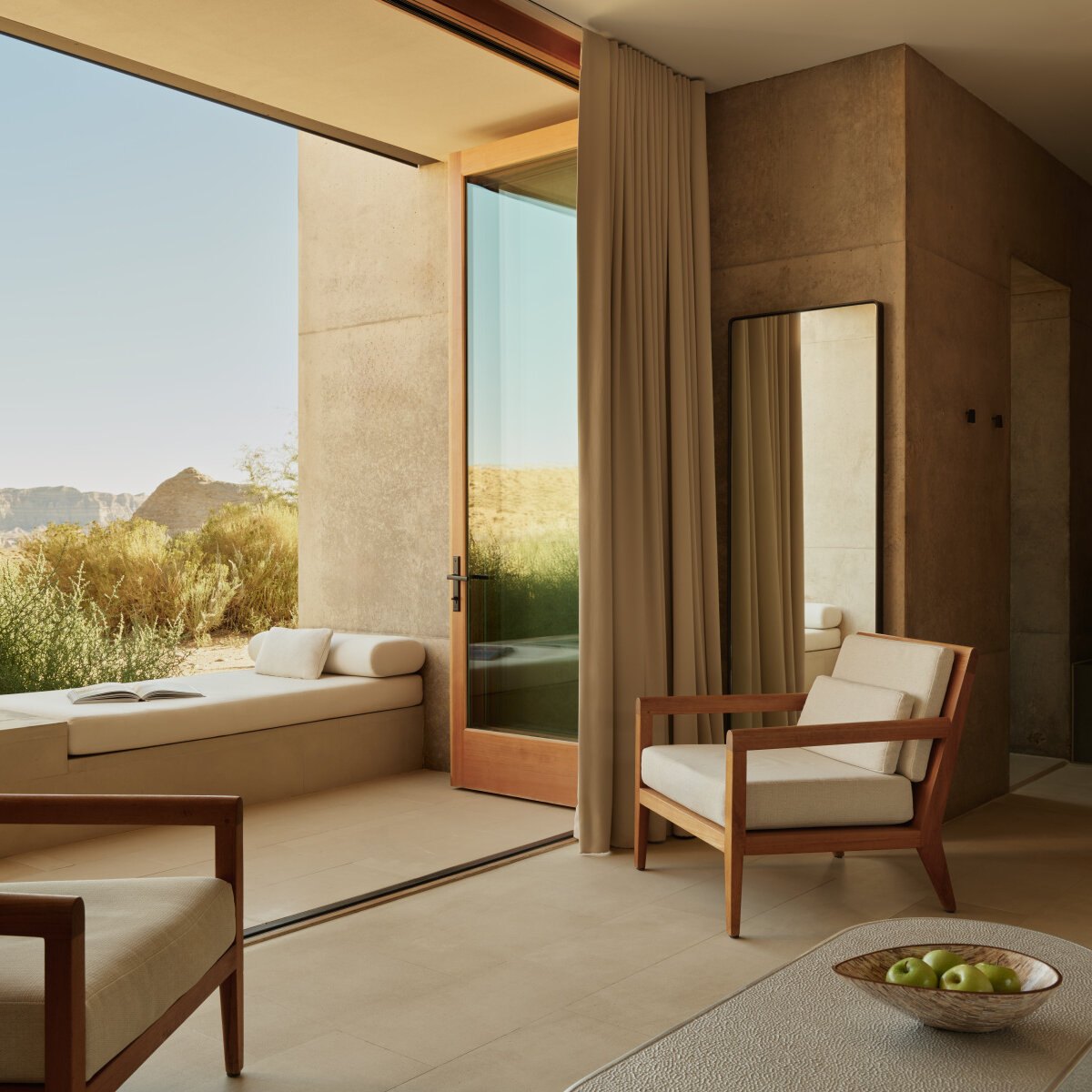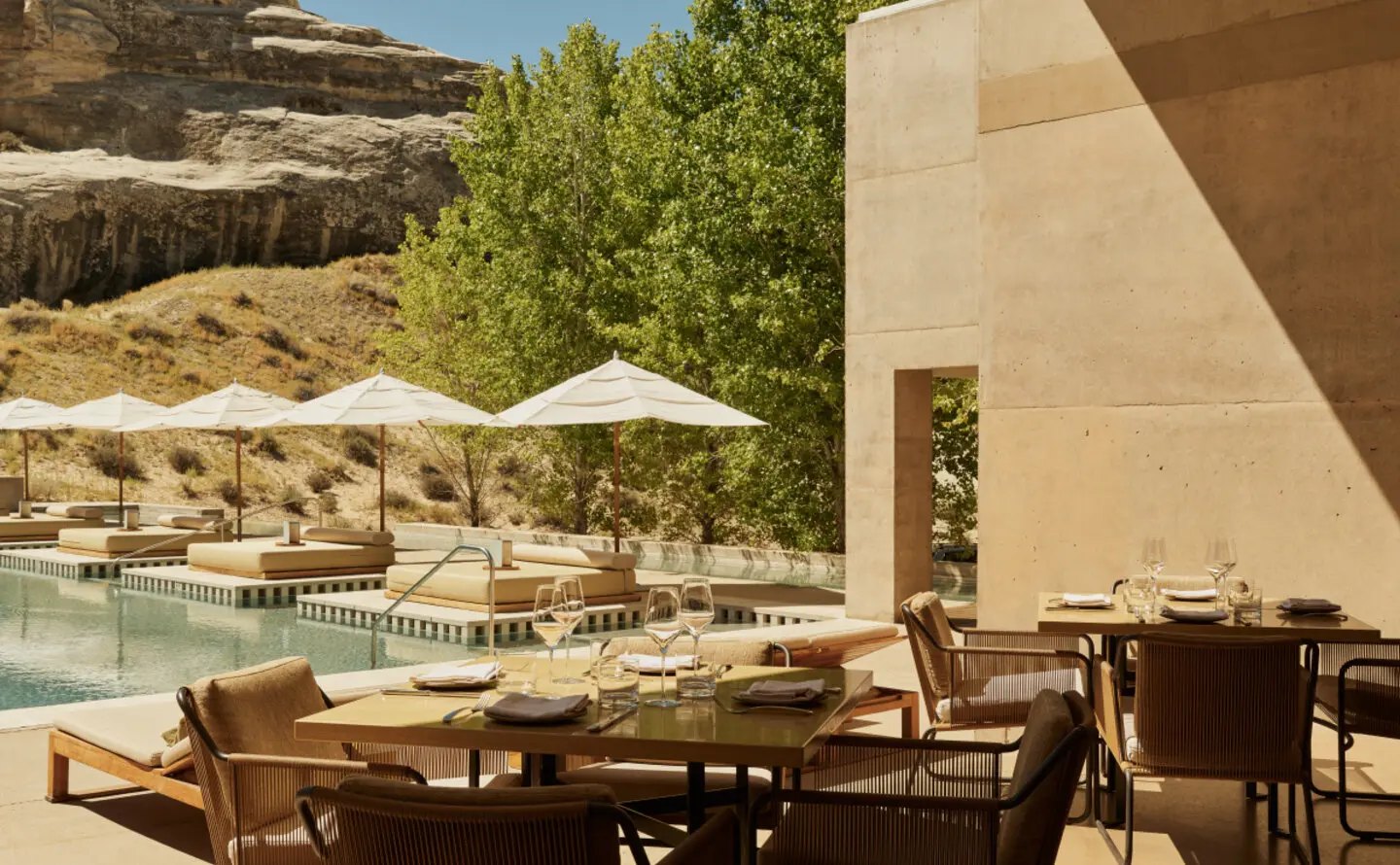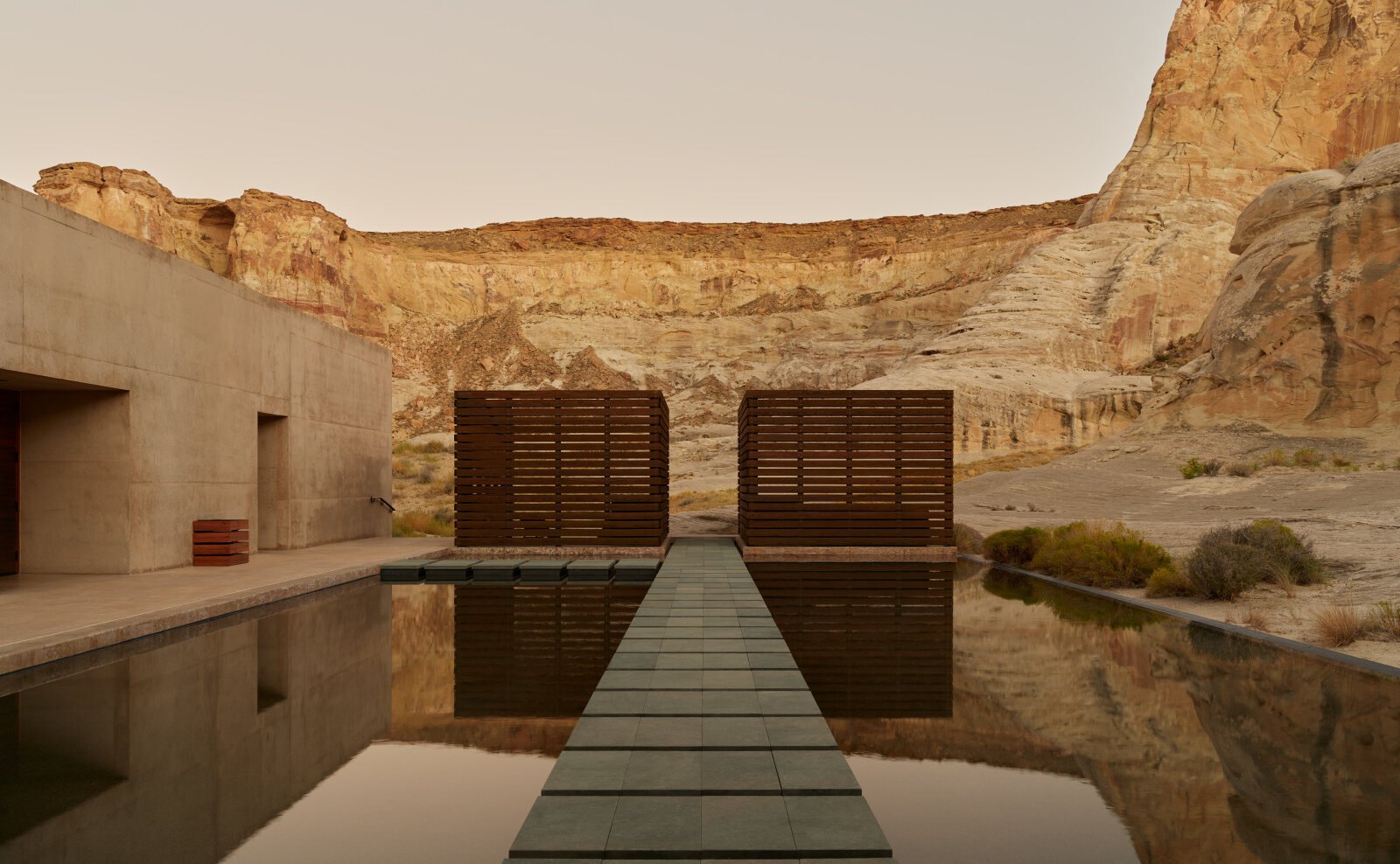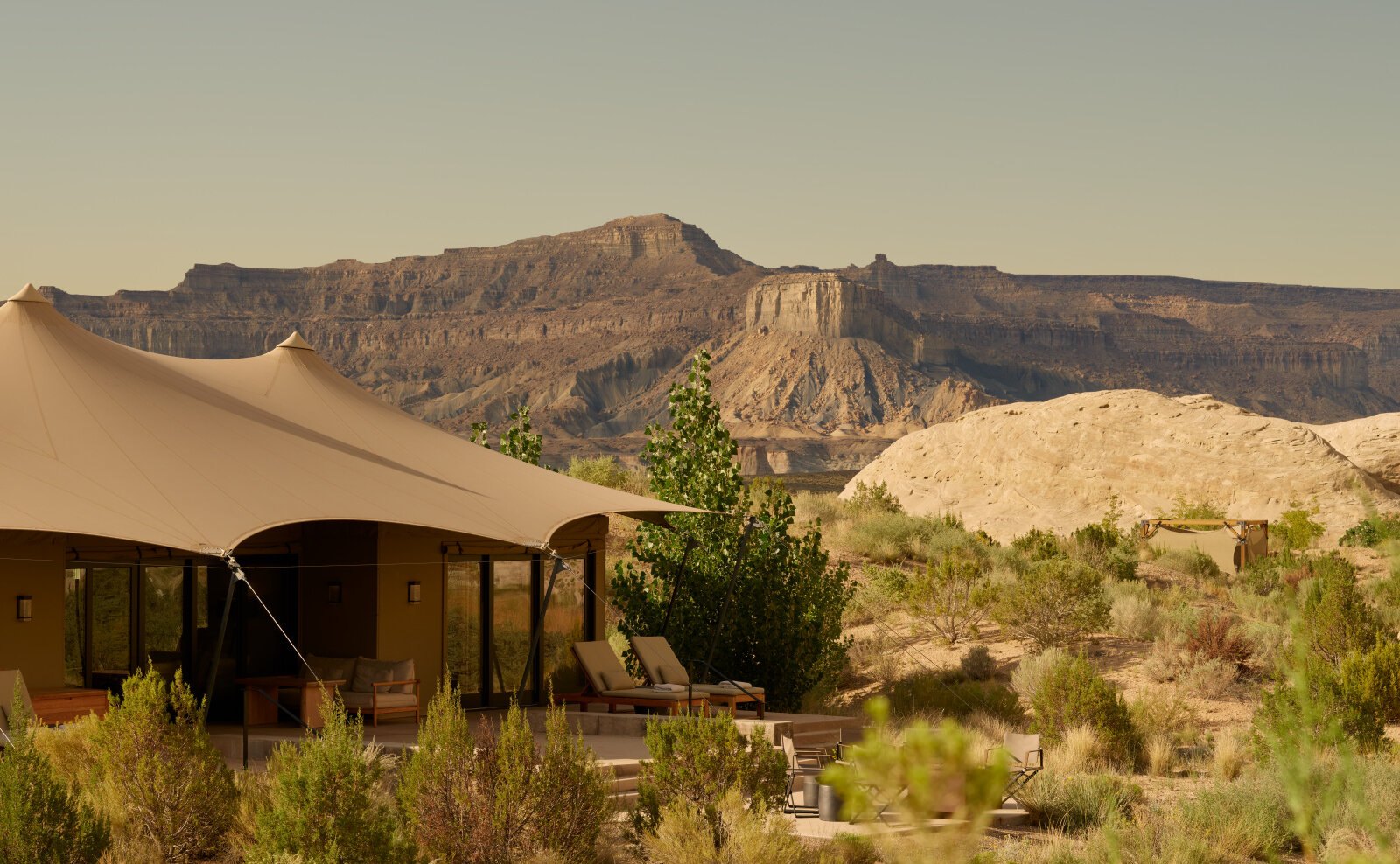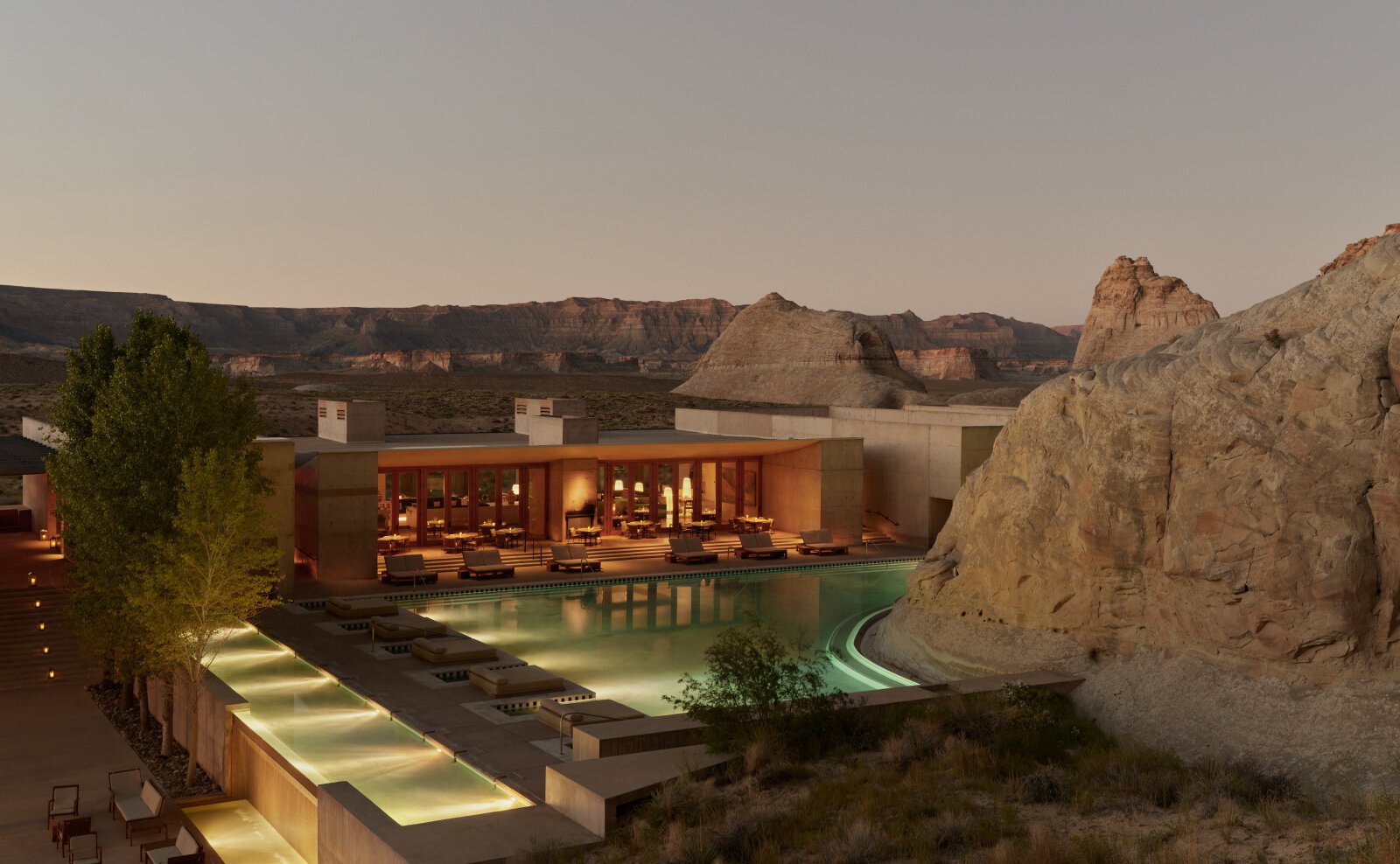
Low horizontal concrete retreat set into warm sandstone mesas in the southern Utah desert at golden sunrise

Aman — Canyon Point, Utah

Where Architecture Meets the Desert

Amangiri is among the most extraordinary architectural retreats ever built — six hundred acres of sandstone on the Utah–Arizona line, where concrete, landscape and silence stopped being separate things.

An Introduction

A house that could not have been built anywhere but here.

Southern Utah does not deal in the human scale. You drive out of Page with the Colorado somewhere to your right and the land simply opens — mesas stacked to the horizon in bands of rust and bone, distances that take an hour to cross and look like ten minutes. Then a gravel track turns off the highway, and for a while you see nothing at all, because there is nothing to see. That is the first thing Amangiri does to you.

The building is there. It has been in view for some time. It is a low grey line pressed against a rock formation, coloured to the ground it sits on, and your eye has been reading it as more desert. Nothing rises above the horizon. Nothing was cut away to make room. The architects — Marwan Al-Sayed, Wendell Burnette and Rick Joy — set the plan around a sandstone escarpment that had been standing there for a very long time, and let it remain the largest object on the property.

What that produces is not a hotel in any useful sense. There is no lobby scene, no arrival theatre, barely a reception. There is a courtyard, a pool wrapped around a rock, and a horizon. You spend the first afternoon adjusting to how little is being offered, and by the second morning you understand that the offer is the desert itself, and that everything built here exists to keep out of its way.

Board-formed concrete wall meeting a natural sandstone rock face behind floor-to-ceiling glass in warm afternoon light

Architecture & Design

Concrete the colour of the ground it stands on

The concrete was mixed to match the sediment of the plateau, poured against rough boards, and left entirely alone. No render, no paint, no softening. Stand a metre from a wall and you can read the grain of the timber that shaped it; stand a hundred metres back and the wall has gone.

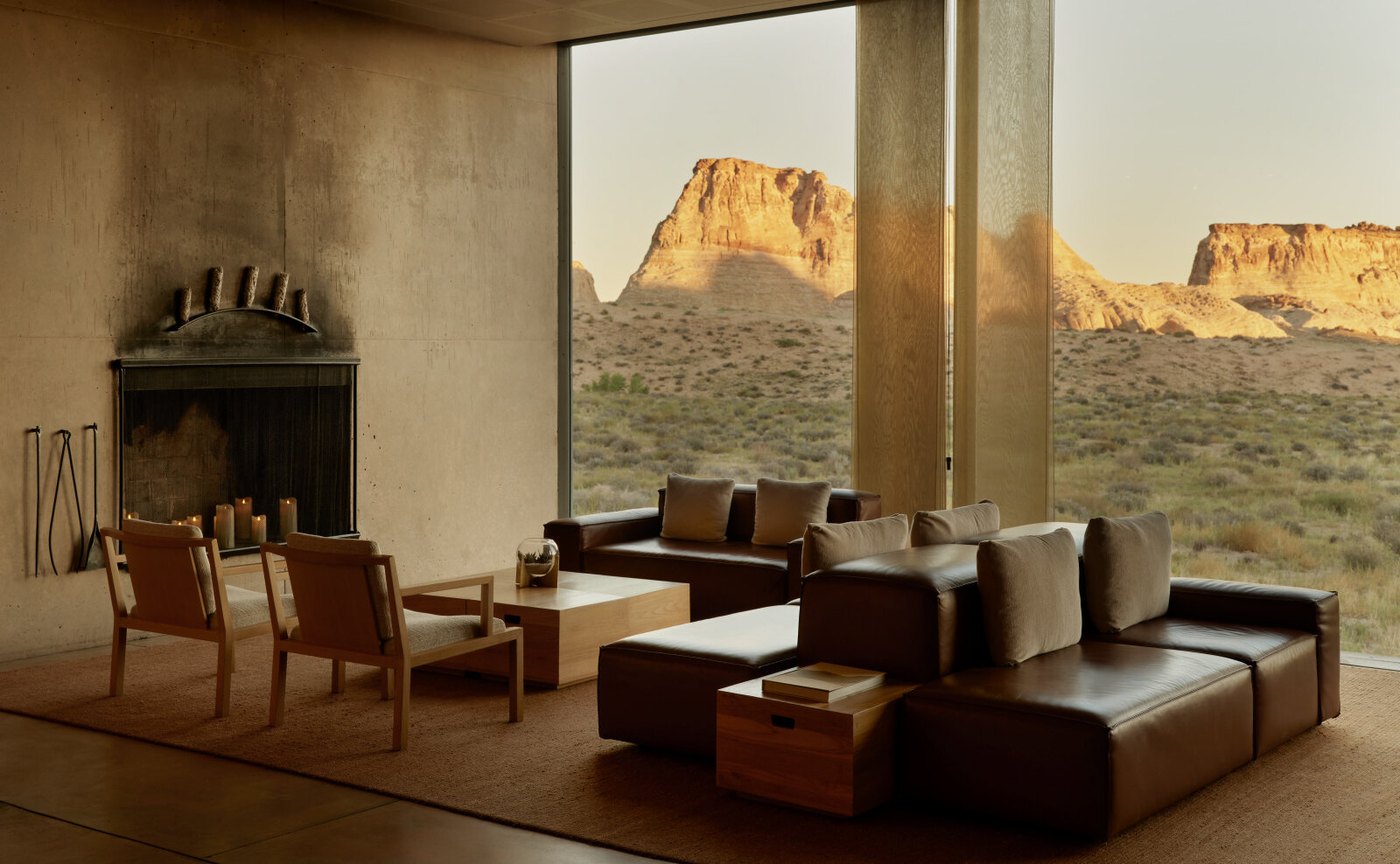
Everything is horizontal. Roofs run flat and long, sightlines are pinned to the line of the mesas, and the glass is set so that each room frames one piece of country and nothing else. Where the rock came through, the building stopped and let it come through.

Then the light does the work. At six the walls are lilac, by nine a cool bone white, at five in the afternoon they burn the same amber as the cliffs behind. Nothing changes but the sun, and the whole place is a different building four times a day. It is the most restrained architecture we know, and the most theatrical.

Suites

Private sanctuaries in the open desert

Thirty-four suites on six hundred acres, set low and far apart. What that buys is not square metres but the certainty that you will not see anyone unless you choose to.

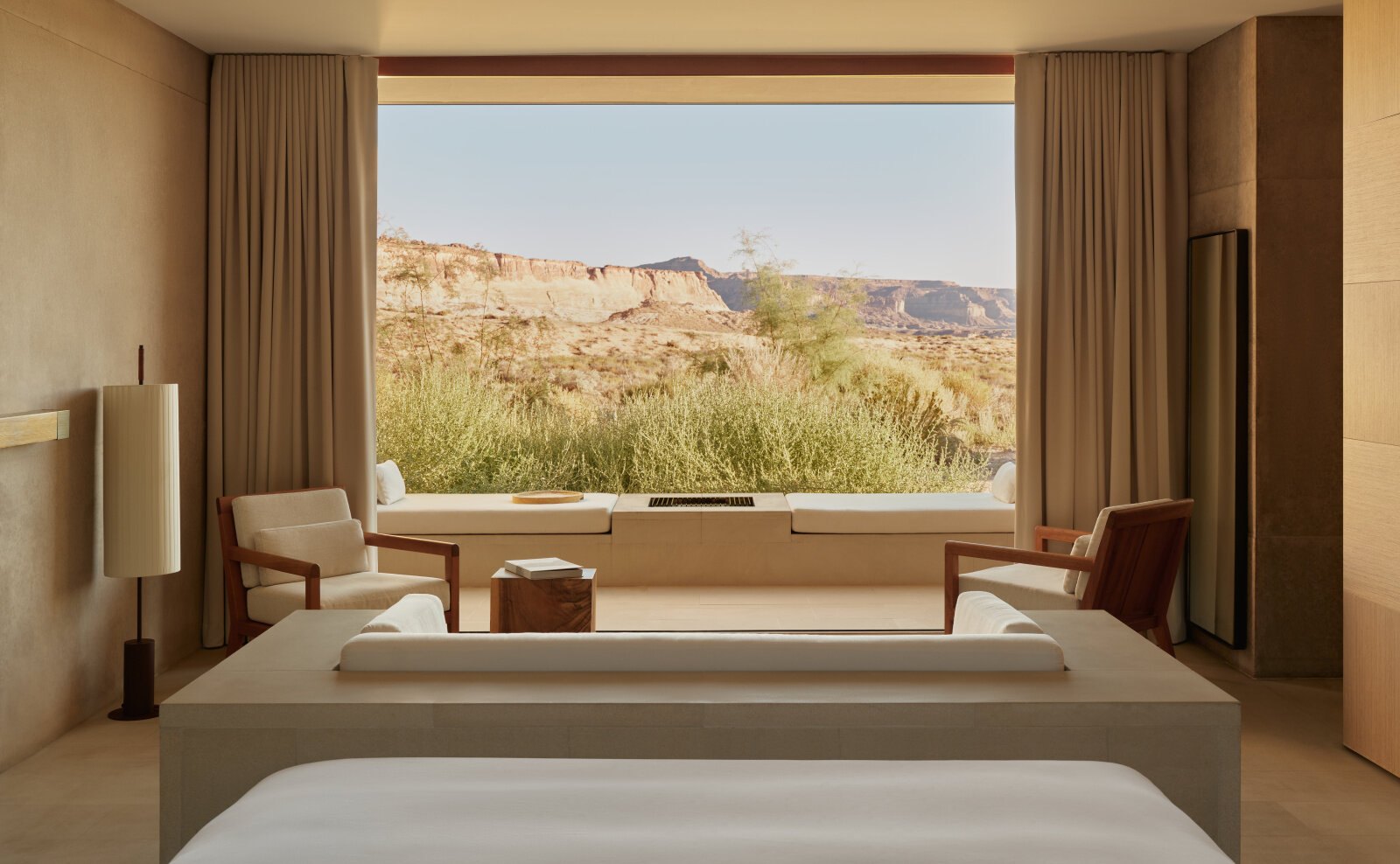
Minimal desert suite with board-formed concrete walls, a low linen bed and floor-to-ceiling glass opening onto red sandstone cliffs at dawn

No. 01

Waking with the Cliffs

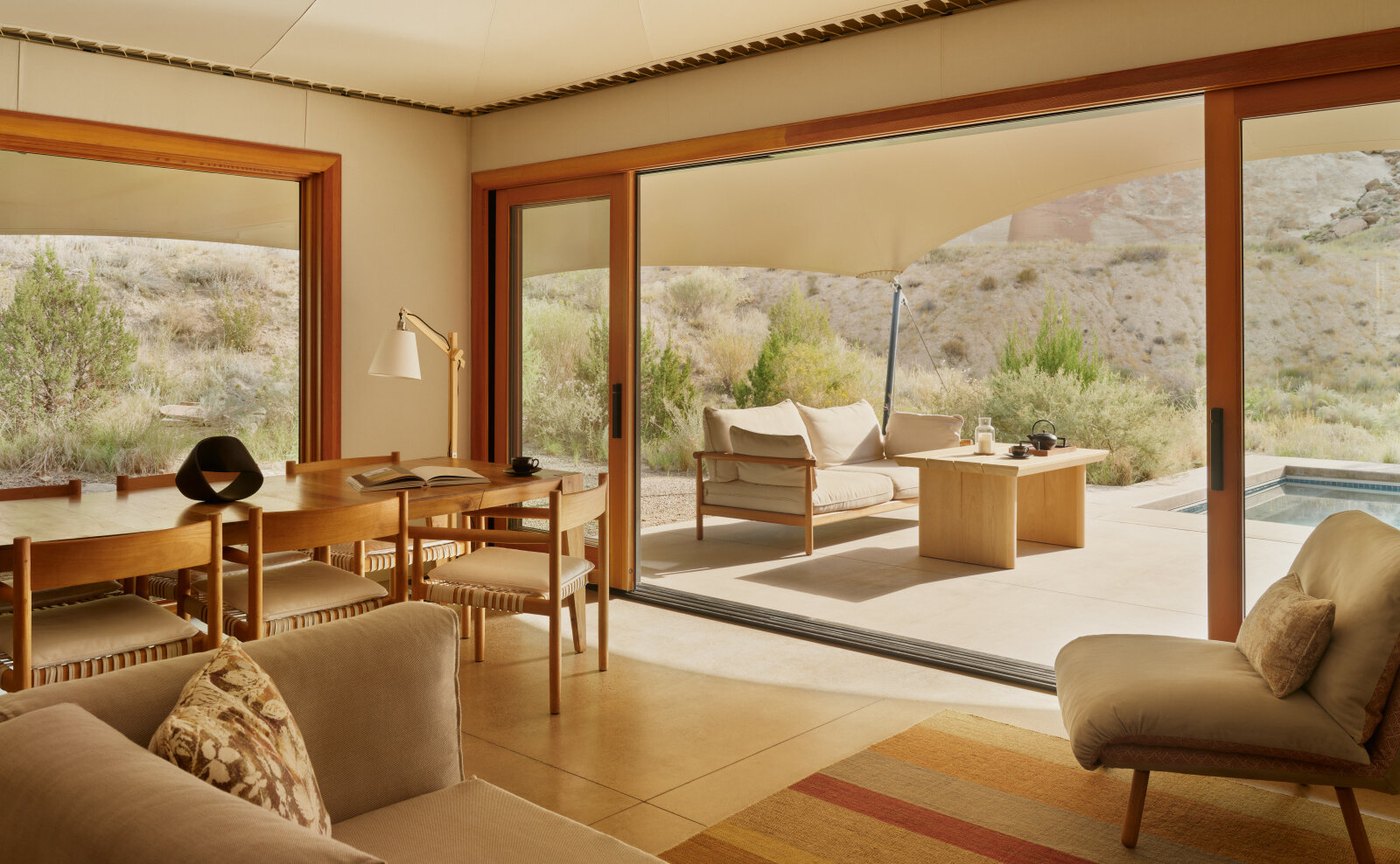
The glass runs the full wall, so the first thing you see is not a room but a mesa. Concrete, pale wood, linen washed soft, a fireplace laid the night before — and beyond it three hundred million years of sediment turning from grey to rose while you are still under the blanket. Nobody knocks. Nothing hums. You lie there longer than you have in years.

Private concrete terrace with a sunken firepit, low linen daybeds, a deep soaking tub behind glass and the Utah desert horizon at dusk

No. 02

The Terrace, and the Hour After Dark

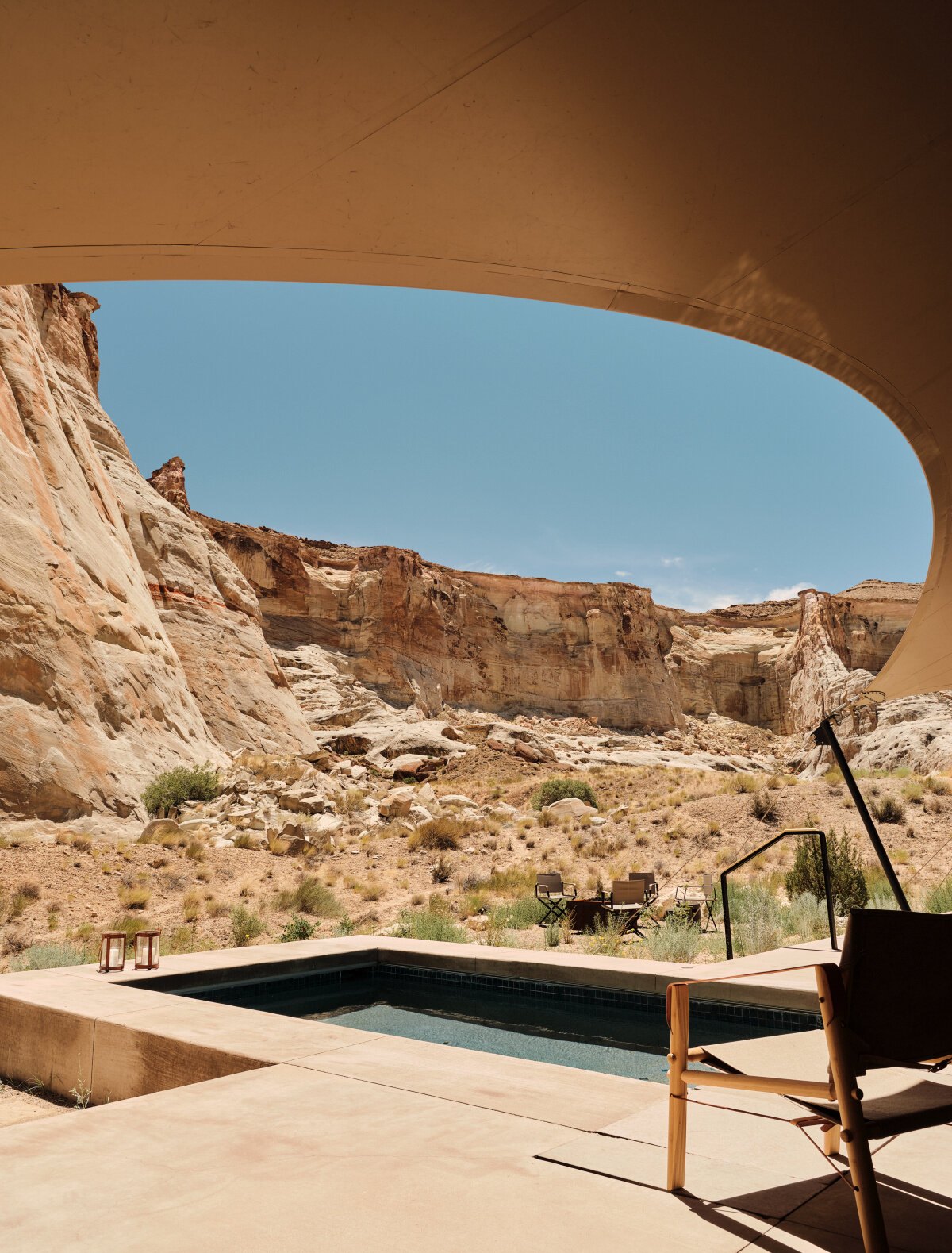
Each suite hands you a stretch of desert of your own: a walled terrace, a firepit sunk into the stone, a tub deep enough to disappear into. The stone holds the heat of the day well past sunset, so you walk out barefoot at nine with a glass in your hand and stand there, and the only thing that moves is the fire.

Open-air dinner on a concrete terrace at sunset with simple ceramic plates of southwestern vegetables, candles and desert mesas behind

Dining

The Southwest, cooked plainly

The kitchen looks close to home: blue corn, squash, beans and chiles from the Four Corners, trout, lamb from the high country, produce that has travelled hours rather than continents. It is cooked with restraint rather than invention, which in a landscape this loud is the right decision.

Most of the year you eat outside. Lunch under shade with the heat standing still on the flat; dinner as the cliffs go from orange to violet to nothing, and the candles become the only light for miles. The kitchen will also set a table out in the desert, which sounds like a flourish and turns out to be the quietest meal of the trip.

Breakfast is the hour to be up for. Coffee on the terrace at six, the air still cold, the first sun coming down the face of the escarpment while nobody else is awake. Nothing on the menu competes with that, and nothing tries to.

Still swimming pool wrapping around a large natural sandstone rock formation with the desert beyond in morning light

Wellness

Wellness begins with silence

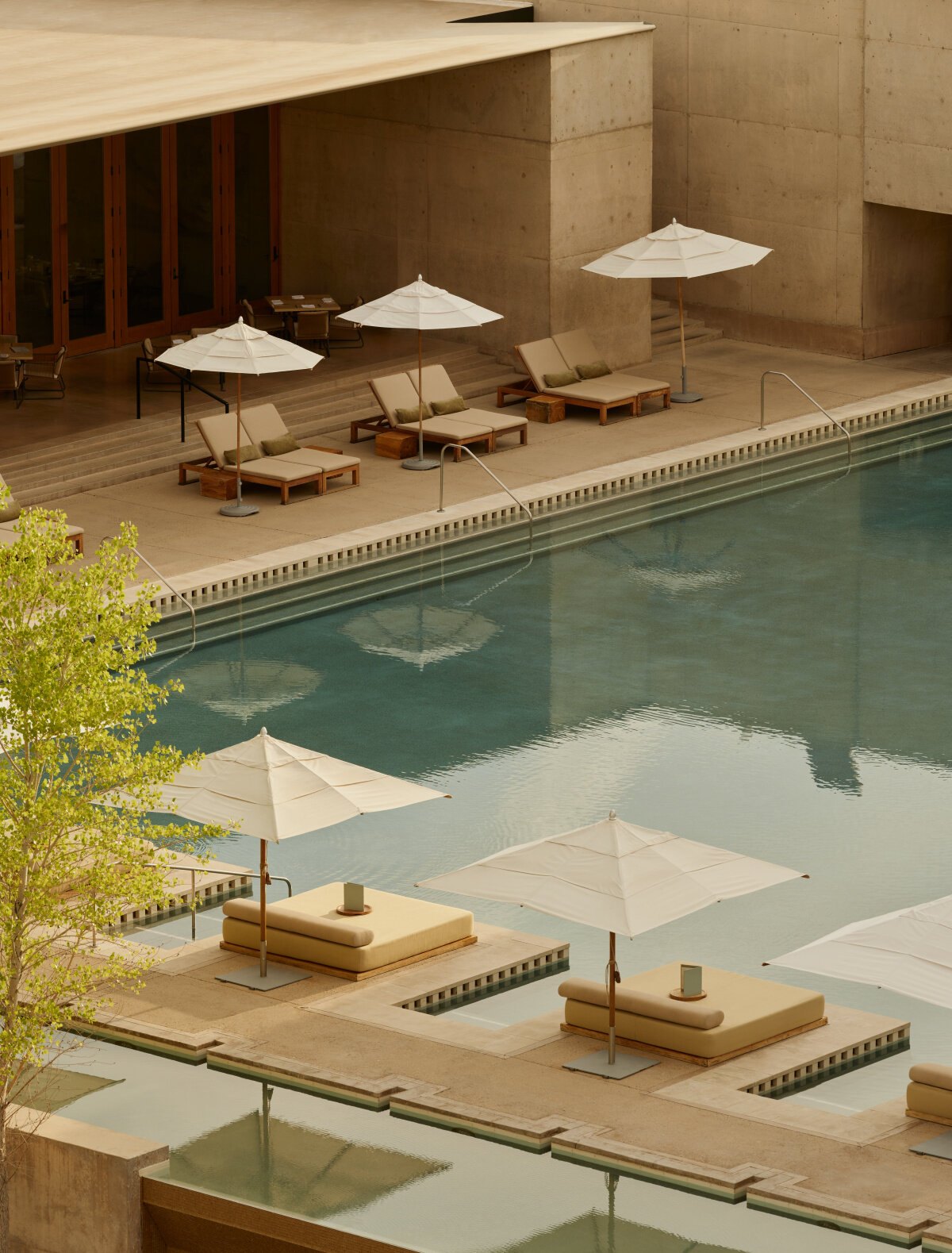
The pool curves around the escarpment rather than away from it, so you swim with a wall of three-hundred-million-year-old rock at your shoulder. Early, before the heat, the water is glass and the reflection of the stone is steadier than the stone. Ten unhurried lengths and the day has already gone somewhere else.

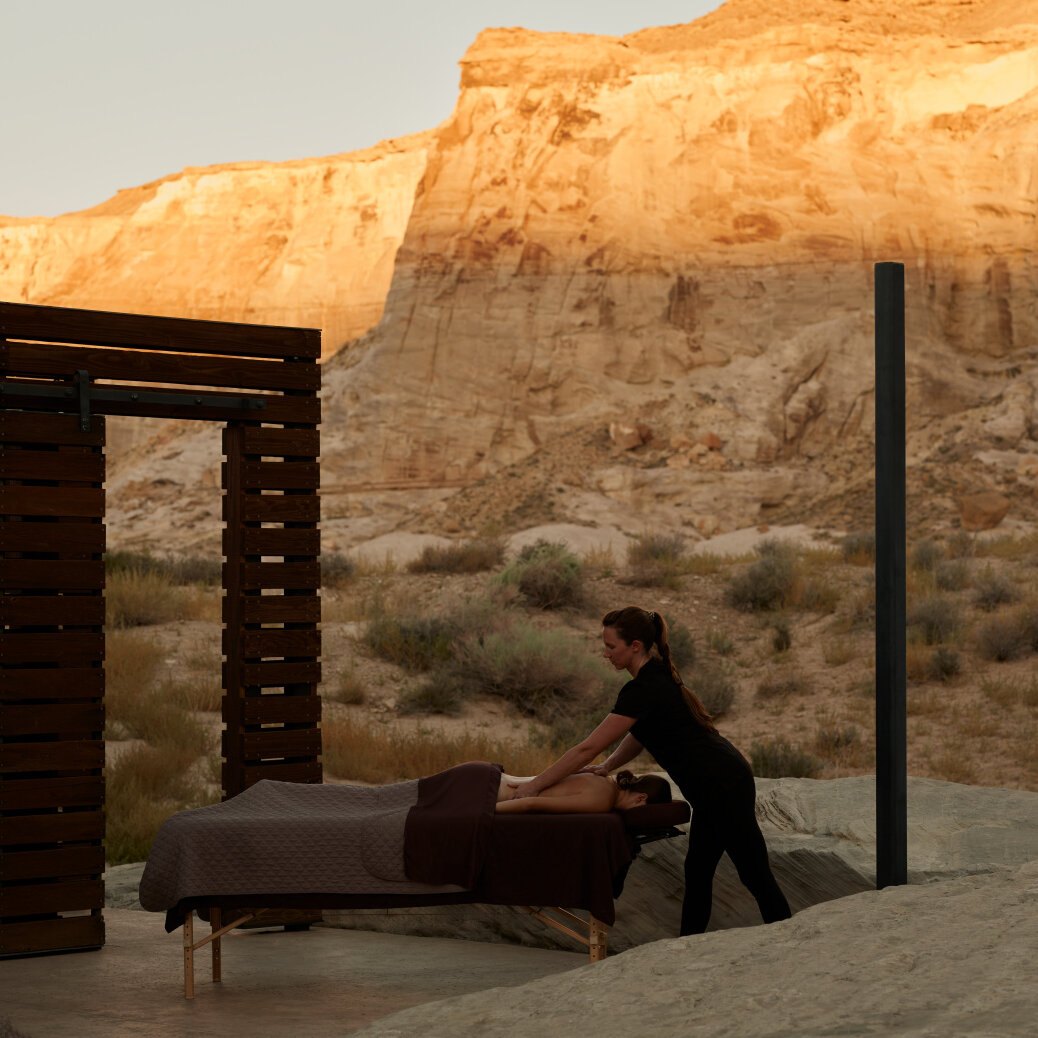
The spa is built as a passage — water pavilion, step pools, flotation, a step room, the walls closing in and then releasing you into light. The therapies draw on Navajo and Hopi healing traditions, worked out with practitioners from the Nation rather than borrowed from them, and they are administered with almost no conversation.

Yoga happens on a deck facing the mesas at first light. Meditation and sound sessions happen where the rock will hold a note. But the treatment that does the most is free and takes no booking: sit outside for twenty minutes and listen to a landscape making no sound at all.

Signature Experiences

Four ways the desert takes you in

Not an activity programme. Four encounters with the same landscape, each of which changes what the others feel like.

  • No. 01

    Above it all, before the wind

    A balloon lifts at first light because that is the only hour the air will allow it. You rise without sound over a landscape that has no scale from the ground, and the mesas arrange themselves below like something drawn. Nobody talks much. There is nothing useful to say.

  • No. 02

    Into the slot canyons, alone

    A guide, a narrow entrance, and then walls that close overhead and turn the light into something liquid. The rock has been carved by water that comes perhaps twice a year. You go in for an hour and come out having lost the argument you were having with yourself about time.

  • No. 03

    The via ferrata, and the horses

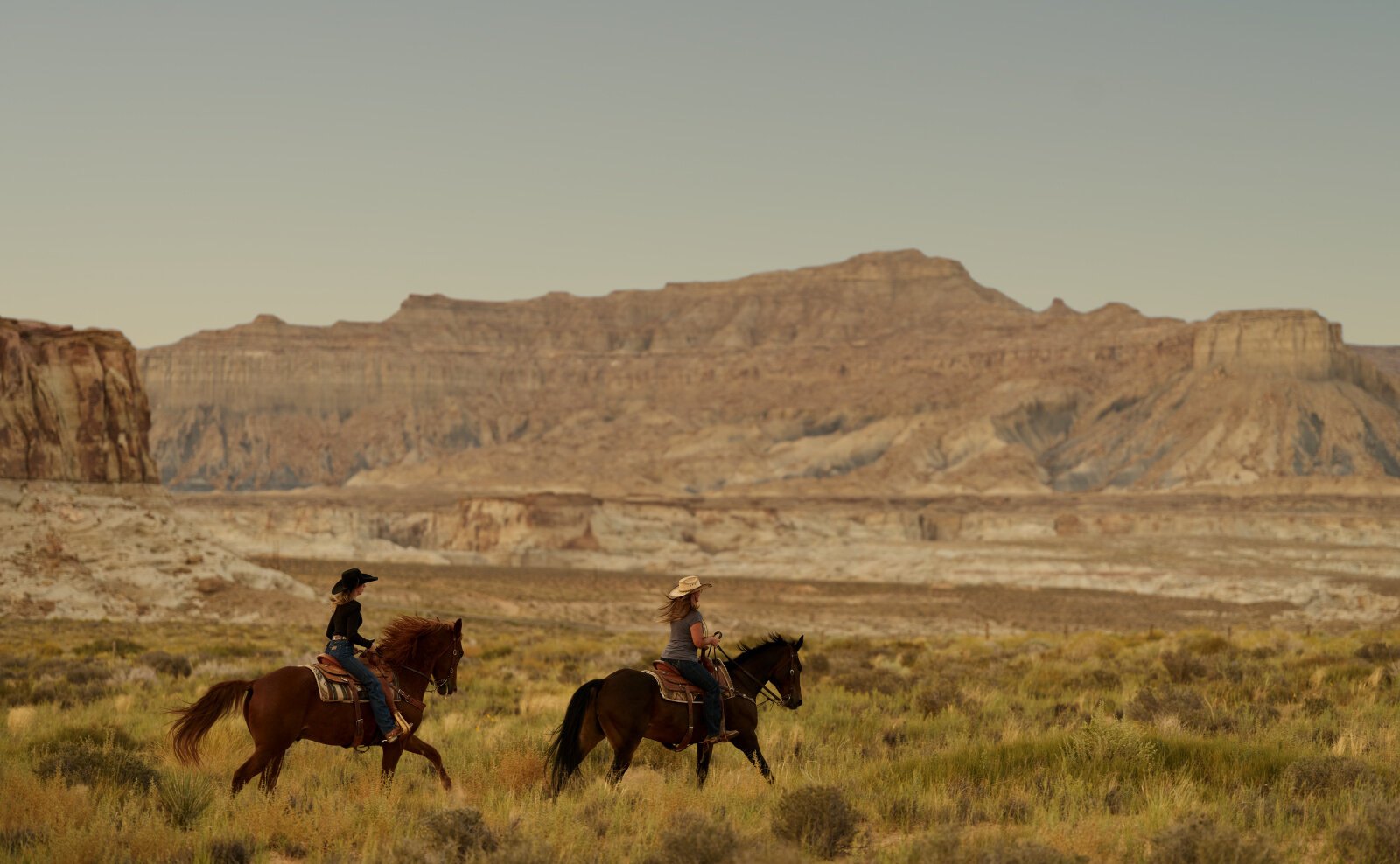
    Two ways to read the same country. On the rungs you are pressed against the sandstone, close enough to see the grain of it. On horseback you cross the flat at walking pace and the desert unfolds slowly, which is the speed it was built to be seen at.

  • No. 04

    Darkness, properly

    This is among the darkest sky in North America, and the difference is not academic. Lie back on warm stone an hour after sunset and the Milky Way is not a smudge but a structure, with depth to it. Most guests stay out far longer than they meant to.

Maison Voyage Loves

Five small things

  • First light arriving on the top of the escarpment and running down it slowly, while the ground is still cold and blue.
  • The pool at six, swum alone around the rock, before anyone has put a towel on a chair.
  • A book on your own terrace in the middle of the afternoon, with no sound at all — not a car, not a bird, nothing.
  • Walking barefoot across the stone an hour after sunset, when it is still holding the heat of the whole day.
  • Lying back on the terrace at ten and watching the Milky Way come up over the canyon with real depth to it.

Who This House Is For

Travellers who are comfortable with nothing happening.

It suits people who read buildings, and people who photograph light. It suits anyone who has ever wanted to be genuinely far from things — for the walking, the bathing culture of the spa, the slow days, the dark sky. It suits couples who do not need to be entertained, and it suits solo travellers extremely well.

It also suits families more than its reputation suggests, provided the children are the kind who will climb a via ferrata and then sit still on a terrace. The desert is a better teacher than most itineraries.

It will not suit everyone, and we would rather say so. There is no nightlife, no shopping, no town within an easy drive, and no traditional resort machinery of clubs and boutiques and bars with a scene. If you need something arranged for every part of the day, the emptiness here will read as absence rather than luxury, and the rates will feel like a lot of money for silence.

Nearby Discoveries

Four things worth the drive

The Colorado Plateau holds more national parks than anywhere in America. These are the four we would actually leave the terrace for.

  • No. 01

    Antelope Canyon, off the hour

    Go with a Navajo guide and go when the tour buses are not there — early, or late, or in a month nobody has recommended. The famous shaft of light is worth seeing once; the quiet stretches of corridor either side of it are worth the morning.

  • No. 02

    Lake Powell, from the water

    Improbable blue against red rock, drowned canyons you can take a small boat into and cut the engine. Half a day is enough. The pleasure is not the lake but the silence inside the side canyons, where the walls throw your own voice back at you.

  • No. 03

    Monument Valley, and whose land it is

    An hour and a half east, on Navajo Nation land. Take a Diné guide rather than the self-drive loop; the buttes are the least of what you will be told about, and the difference between a photograph and an understanding is the person beside you.

  • No. 04

    Zion, Bryce and the long road between

    Both are day trips, and both reward leaving before dawn — Zion for the canyon floor before the shuttles, Bryce for the hoodoos while they are still pink. Grand Staircase-Escalante lies in between, mostly empty, and is the drive people remember.

A Personal Enquiry

Planning Your Stay?

If this hotel feels like the right place for your next journey, we would be delighted to curate your stay personally.

Maison Voyage specialises in carefully crafted luxury travel experiences tailored entirely to you.

Why book through Maison Voyage?

  • Personal luxury travel advice
  • Carefully curated hotel recommendations
  • Tailor-made itineraries
  • Exclusive partner benefits whenever available
  • Direct personal contact from start to finish

No booking is made and nothing is charged. We simply begin a conversation.

From the Journal

Related reading

All stories
  • Two simple chairs on a stone terrace facing distant desert mesas at dawn

    The World's Most Beautiful Desert Hotels

    HotelsJuly 2026

    From the Utah plateau to the Wadi Rum and the Atacama. Nine houses built in places where there is nothing, and what the nothing does to you.

  • Raw concrete wall meeting desert scrub with a long horizontal roofline barely visible in the landscape

    Architecture That Disappears

    ArchitectureJune 2026

    On the buildings that decline to be the view. Concrete, colour-matched to the ground it stands on, and the discipline of designing something meant not to be noticed.

  • Empty desert plain of dry grasses with distant buttes under a pale wide sky

    The Silence of the American Southwest

    Slow TravelMay 2026

    Two weeks driving between the Colorado Plateau's parks with the radio off. A note on scale, on emptiness, and on how long it takes to stop reaching for the phone.

A Note from the Editor

Come in late October, and stay four nights.

The heat has broken, the light is long and low all day, and the nights are cold enough to want the fire. Three nights is the shortest stay that works: one to arrive and stop, one for the canyons, one for doing nothing whatsoever. Add the fourth. It is the one people describe afterwards.

Ben Trousil, Founding Editor

An Invitation

Continue the Journey

One letter each month: a place worth the detour, an object worth keeping, a page worth reading slowly. Nothing more.