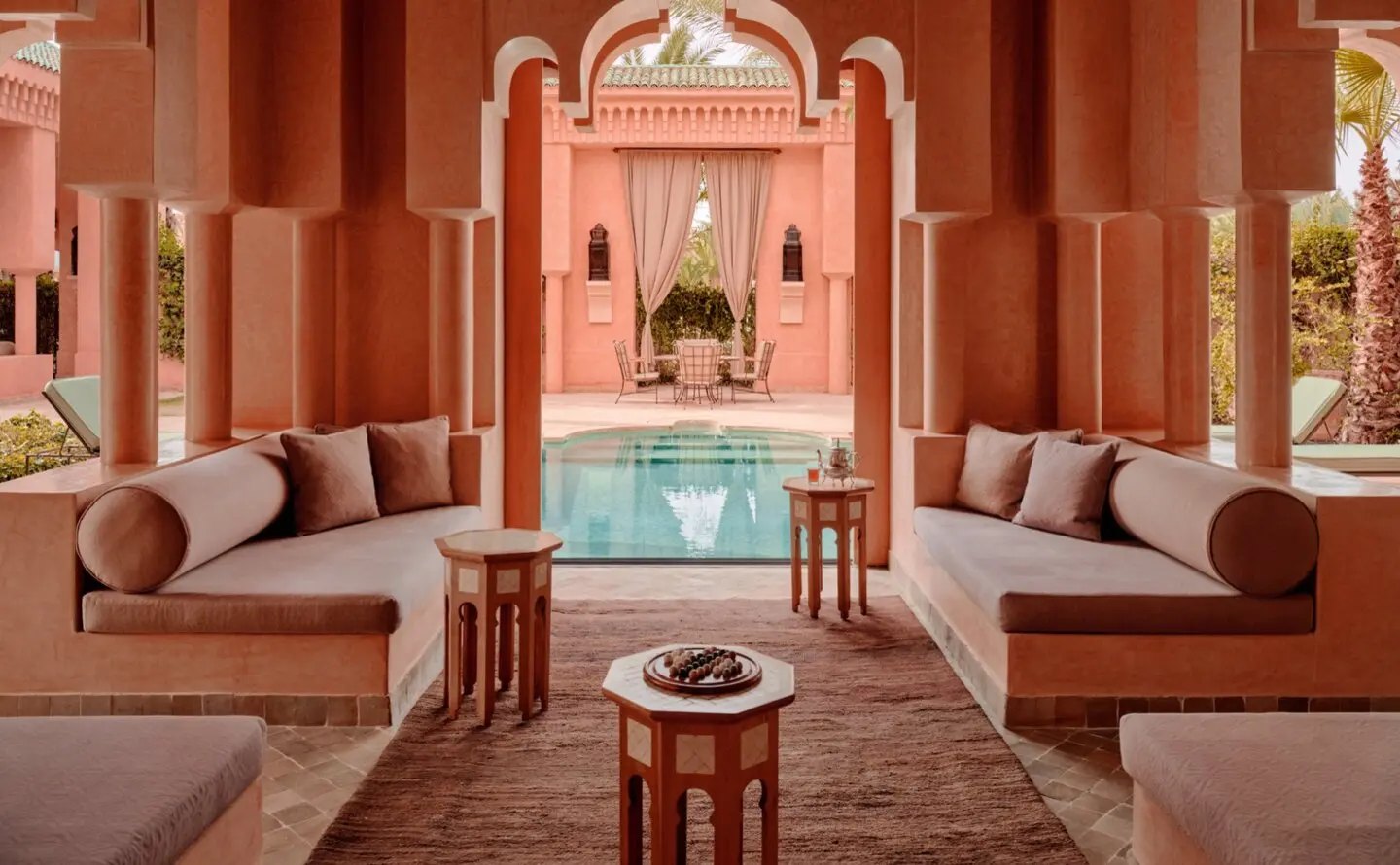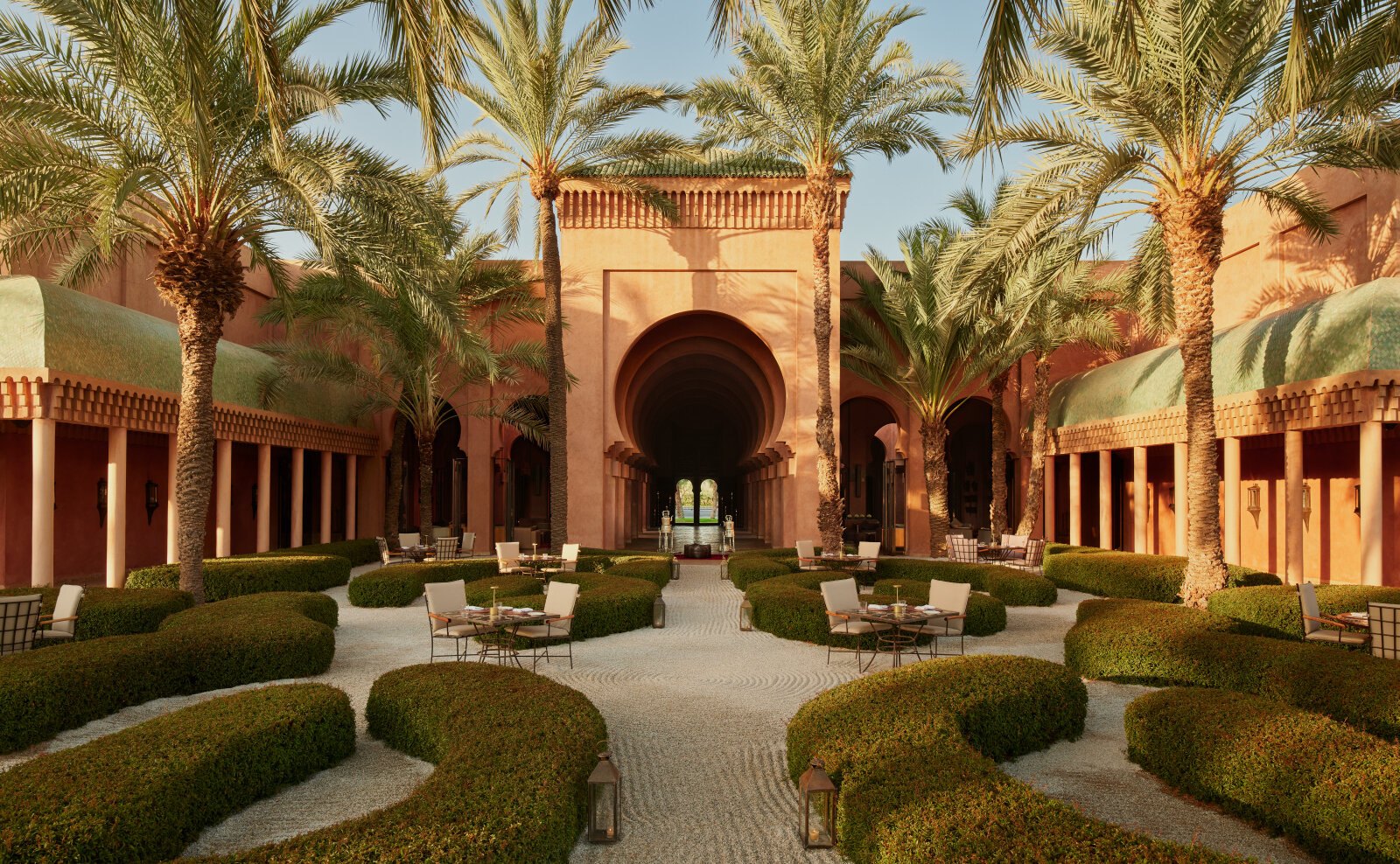
Rose-coloured Moorish pavilion mirrored in a long reflecting pool at Amanjena near Marrakech, framed by olive trees, date palms and the Atlas Mountains at golden hour

Marrakech — The Haouz Plain, Morocco

A Palace Of Light And Silence

Just beyond the vibrant energy of Marrakech, Amanjena offers a timeless sanctuary where Moorish architecture, tranquil gardens and Moroccan craftsmanship invite guests to slow down and experience the city's quieter soul.

An Introduction

A city of noise, and the water fifteen minutes past its edge.

Marrakech arrives through the nose before anything else. Cumin and charcoal, orange blossom from a courtyard you cannot see, dust off the plain, mint crushed in somebody's hand, and underneath all of it the warm mineral smell of pisé walls that have been standing in the sun since the twelfth century. It is a city the colour of the earth it was built from, which is a particular rose-brown that changes four or five times between morning and dusk and is never quite the same colour twice.

Inside the medina the noise is total and entirely benign. Scooters, hammering, bargaining, a hundred cats, wool being dyed and hung dripping across an alley, a cart of mint being pushed through a crowd that parts without looking. At dusk the square fills with smoke and drums. Everyone tells you it is overwhelming, and it is, and it is also one of the great living cities of the world — a place where things are still made by hand within a hundred metres of where they are sold.

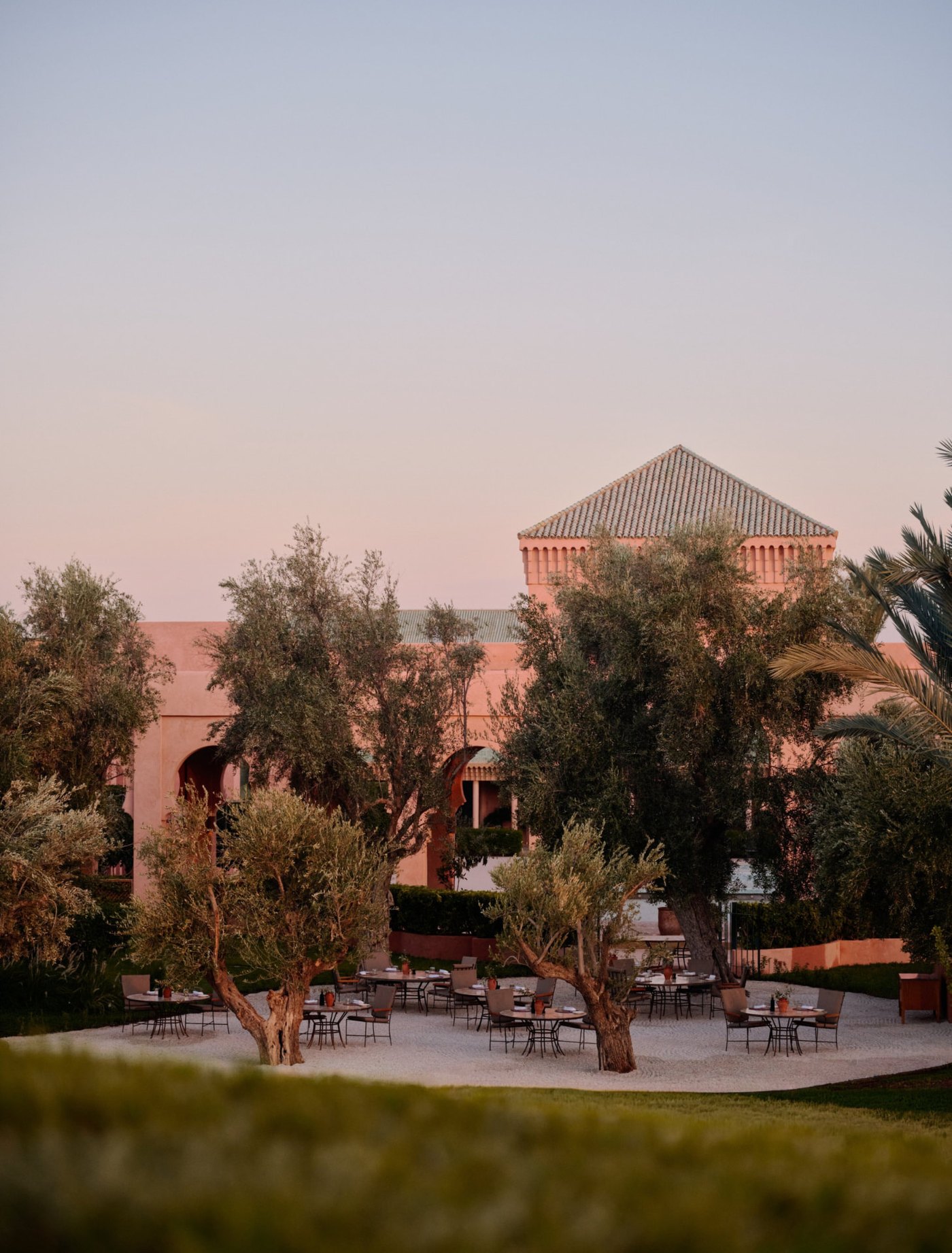
Then you drive south-east for fifteen minutes, past the last of the new villas, along a road lined with eucalyptus, and turn between two walls into an olive grove. The gate closes. The first thing you notice is not the architecture. It is that the sound has gone — replaced, precisely and deliberately, by water. A channel runs the length of the entrance court. Somewhere ahead of you a fountain is doing what it has been doing all day. Birds are audible again. So is your own footfall on terracotta.

Amanjena means, roughly, peaceful paradise, and it was the first Aman built in Africa — Ed Tuttle's answer to Moorish Morocco, opened in 2000 on twenty-three hectares of grove between the city and the mountains. The great basin at its centre is a bassin, the ancient agricultural reservoir the Almohads used to hold snowmelt from the Atlas. Nothing here was invented. It was borrowed, carefully, from a landscape that had already solved the problem of heat, light and water eight hundred years ago.

This is the part worth saying plainly: staying here is not a way of avoiding Marrakech. It is another way of understanding it. The medina and the grove are the same civilisation expressed at two different volumes — the same arches, the same tiles, the same cedar cut by the same families, the same obsession with shade and running water. One is the city arguing with itself. The other is the city at rest.

You will go in most days, and you will come back out. And each time the gate closes behind you, the drive will feel shorter and the silence will feel more like something Morocco gave you rather than something a hotel arranged.

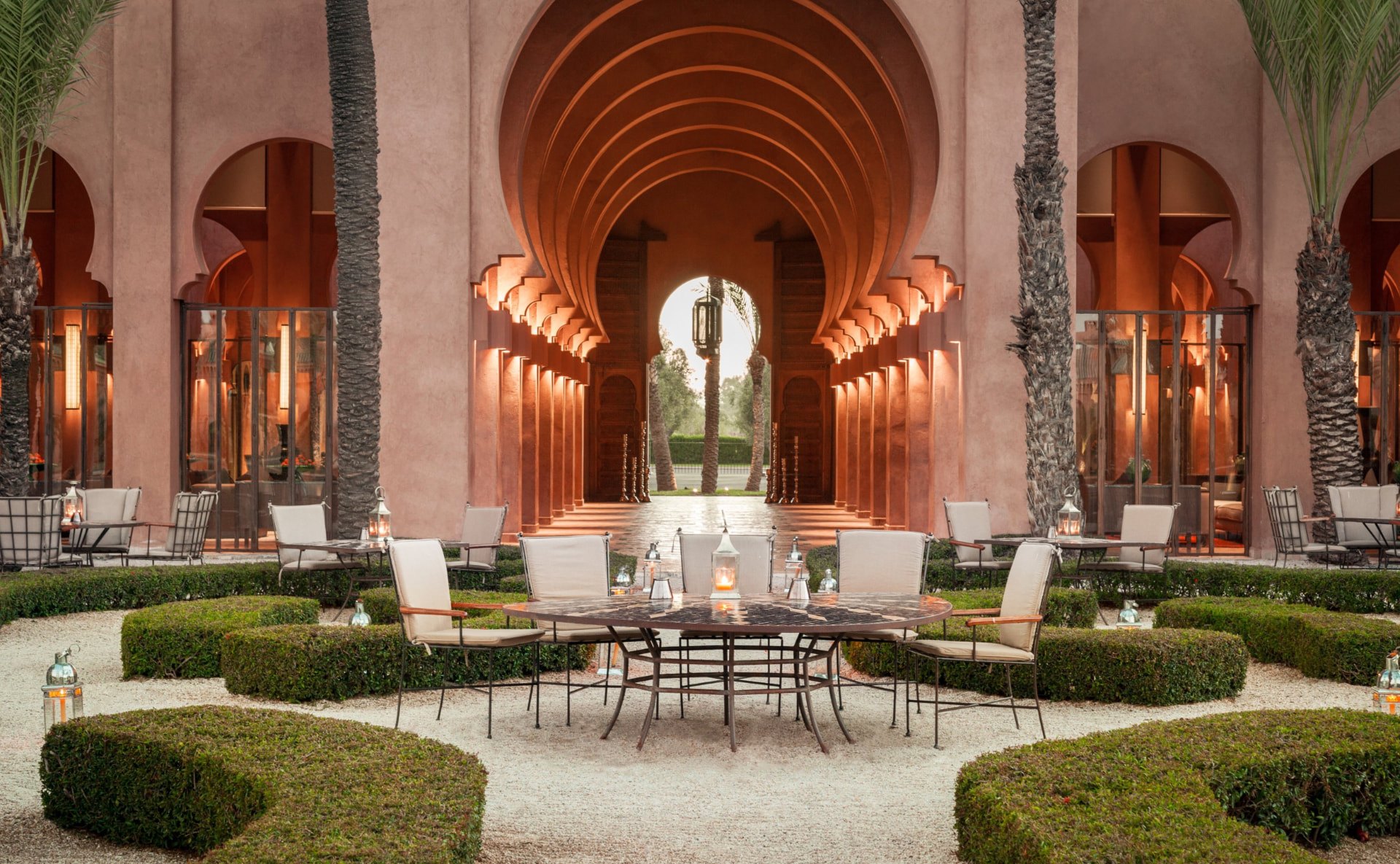
Rose-pink Moorish arches, carved cedar ceiling, zellige tilework and a stone fountain in a quiet Moroccan courtyard in warm natural light

Architecture & Design

Proportion, shade, and one long line of water

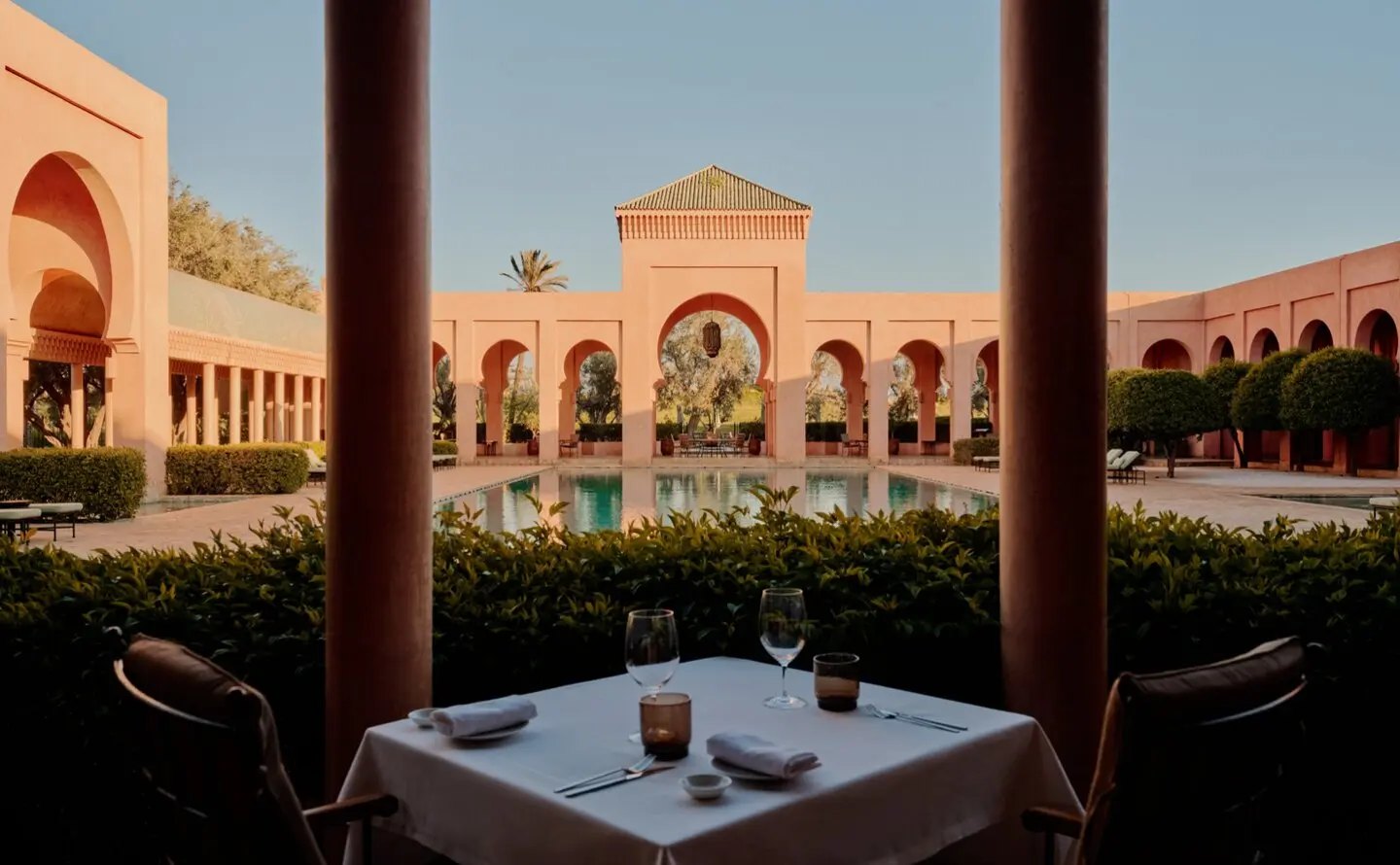
Everything is organised around the axis of the bassin — a still rectangle of green water with a pavilion at one end and the Atlas somewhere beyond it, holding the whole composition in place. Walk anywhere on the estate and you are walking either towards water or alongside it. The gardens follow the same grammar: olive, palm, cypress, citrus, arranged in the geometry Moorish gardeners settled on centuries ago because it works in this heat.

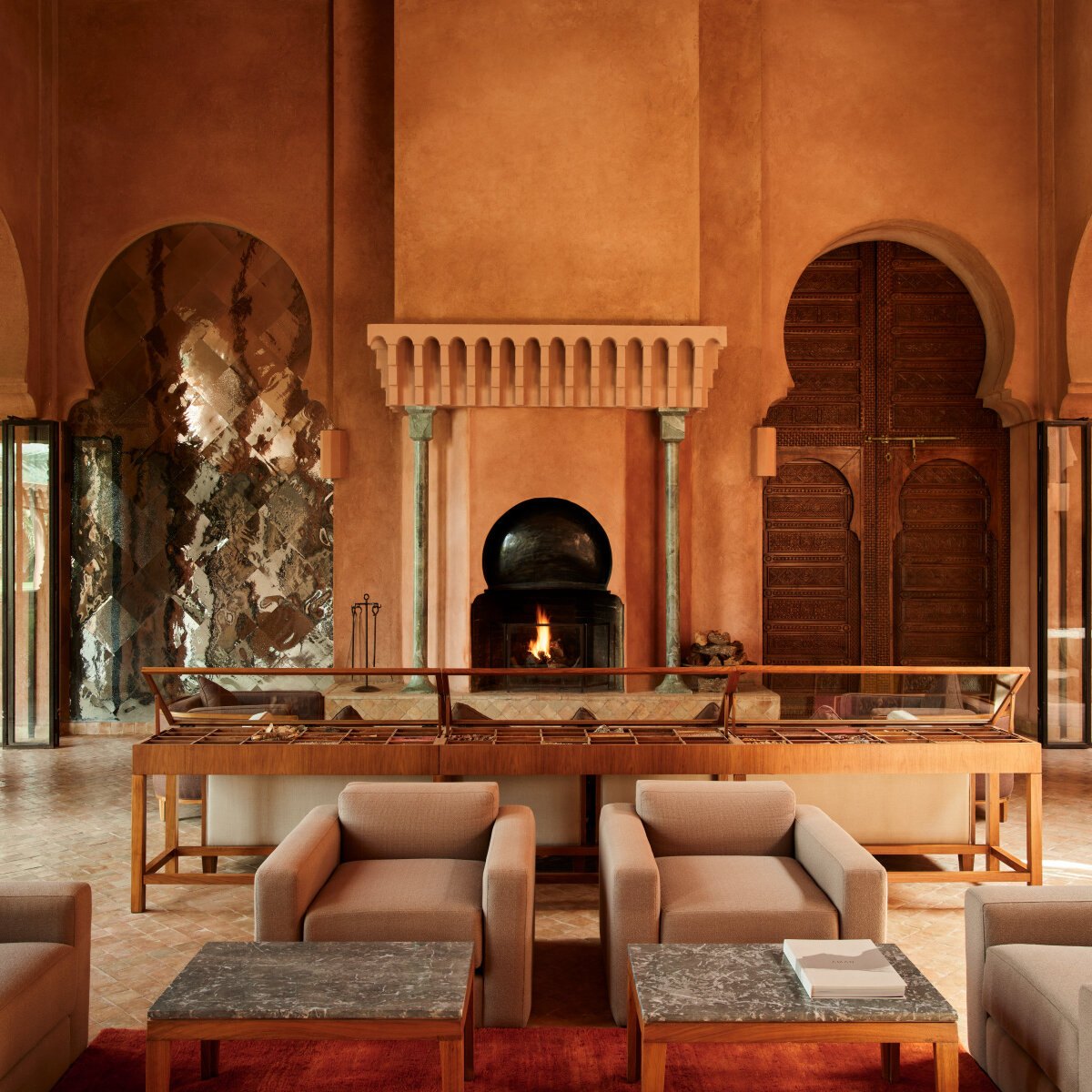
The walls are pisé, rammed earth the colour of the plain, and they behave like the plain — pink at dawn, almost coral at six in the evening, ochre by night. Arches repeat down colonnades until the repetition itself becomes calming. Above the domes, green tile. Below, terracotta laid by hand. In the shadowed interiors: zellige cut tile by tile, carved cedar that took months, stucco worked wet with a knife and never touched again.

Ed Tuttle's discipline was restraint. There is almost no ornament that is not structural, almost no colour that did not come out of the ground nearby. Rooms are tall, doorways are narrow, courtyards are cool, and the light is rationed through screens so that it arrives as pattern rather than glare. Luxury here is a consequence of proportion — of a wall standing in exactly the right place — and the longer you stay the more decoration everywhere else begins to look like apology.

Pavilions & Maisons

Houses arranged around water

There is nothing to recite here. What matters is the temperature of a wall at six in the evening, and how long you stay outside to feel it go.

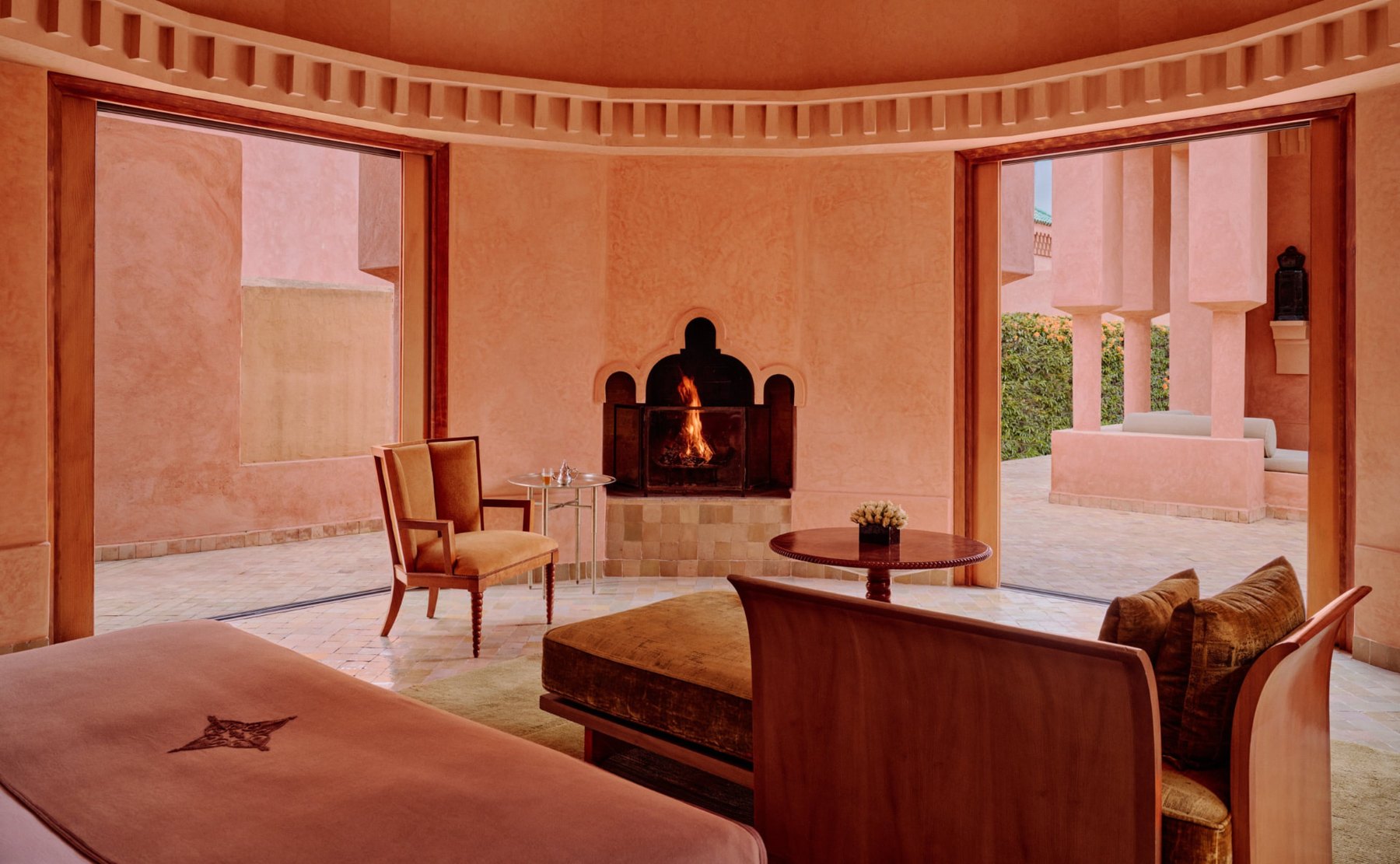
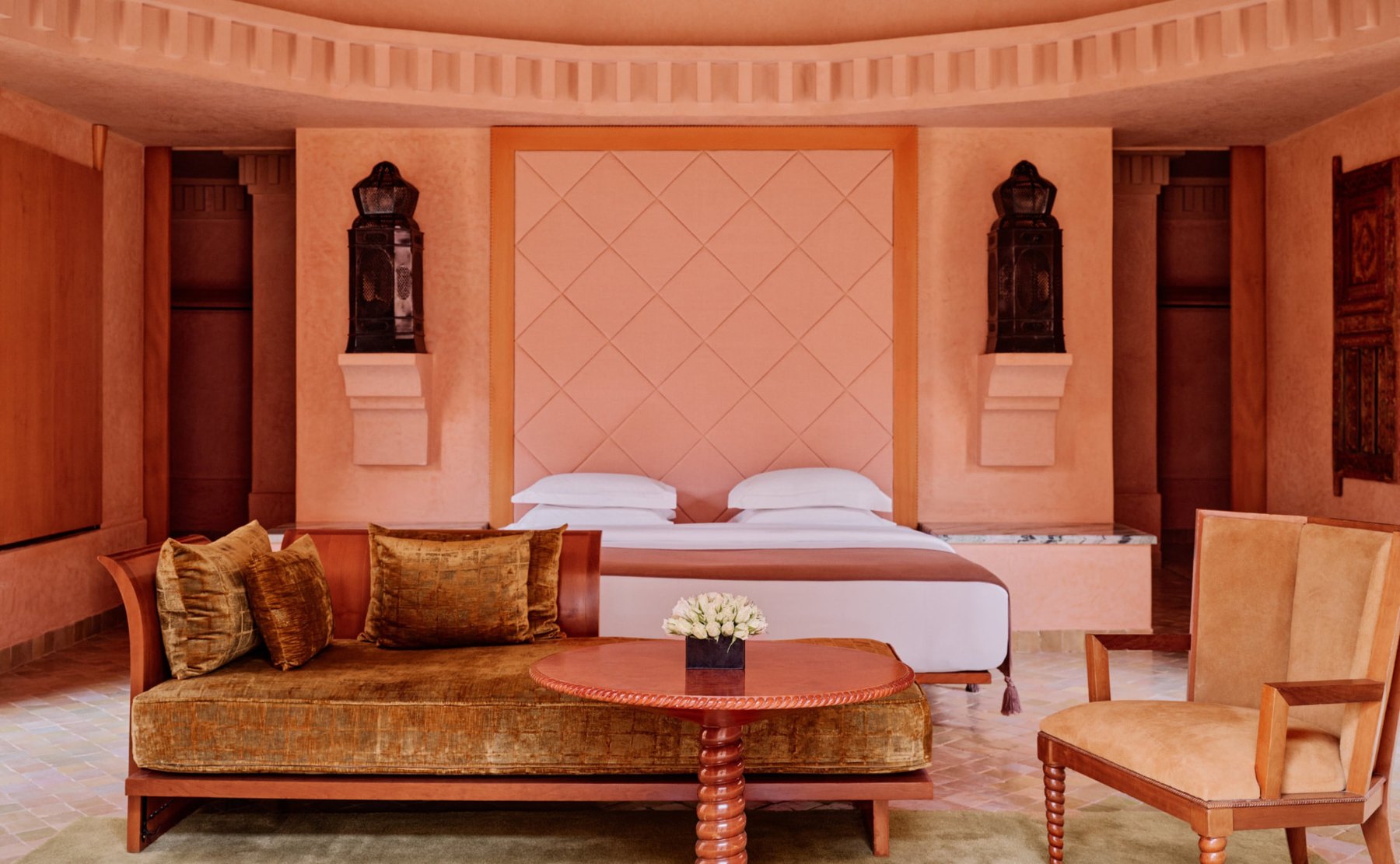
Moroccan pavilion bedroom at dawn with a high white domed ceiling, carved cedar doors, pale linen and geometric light falling through a moucharabieh screen

No. 01

Waking Beneath A Dome

The first thing is the light, and the shape it arrives in. It comes through a cedar screen cut into a pattern somebody worked out several centuries ago, and it lays that pattern across the floor, and over the next hour it moves — slowly, without any sound at all — up the wall and out of the room. Above you the dome holds the cool of the night a little longer than the rest of the house. The linen is heavy and unbleached. The walls are tadelakt, polished with stone until they hold light the way skin does. Nothing here asks anything of you. You lie still, watching the pattern travel, and understand that you have been given a room whose only purpose is to make the passing of a morning visible.

Private walled Moroccan courtyard at golden hour with a small heated pool, rose-coloured pisé walls, an olive tree, terracotta paving and unlit lanterns

No. 02

A Courtyard Of One's Own

By late afternoon the walls have taken all the heat the day had to give, and they hand it back slowly, and the courtyard becomes the warmest and quietest place you know. There is water in it, a small pool the colour of green glass, held between terracotta and rose. An olive tree makes its own weather overhead. Somewhere beyond the wall the gardeners are working and you can hear the sound of a rake on gravel, which is a sound with no urgency in it whatsoever. Later the light turns copper and the swifts come out over the palms, and then the muezzin, faint from the direction of the city. You do not go inside. Nobody who stays here goes inside at that hour.

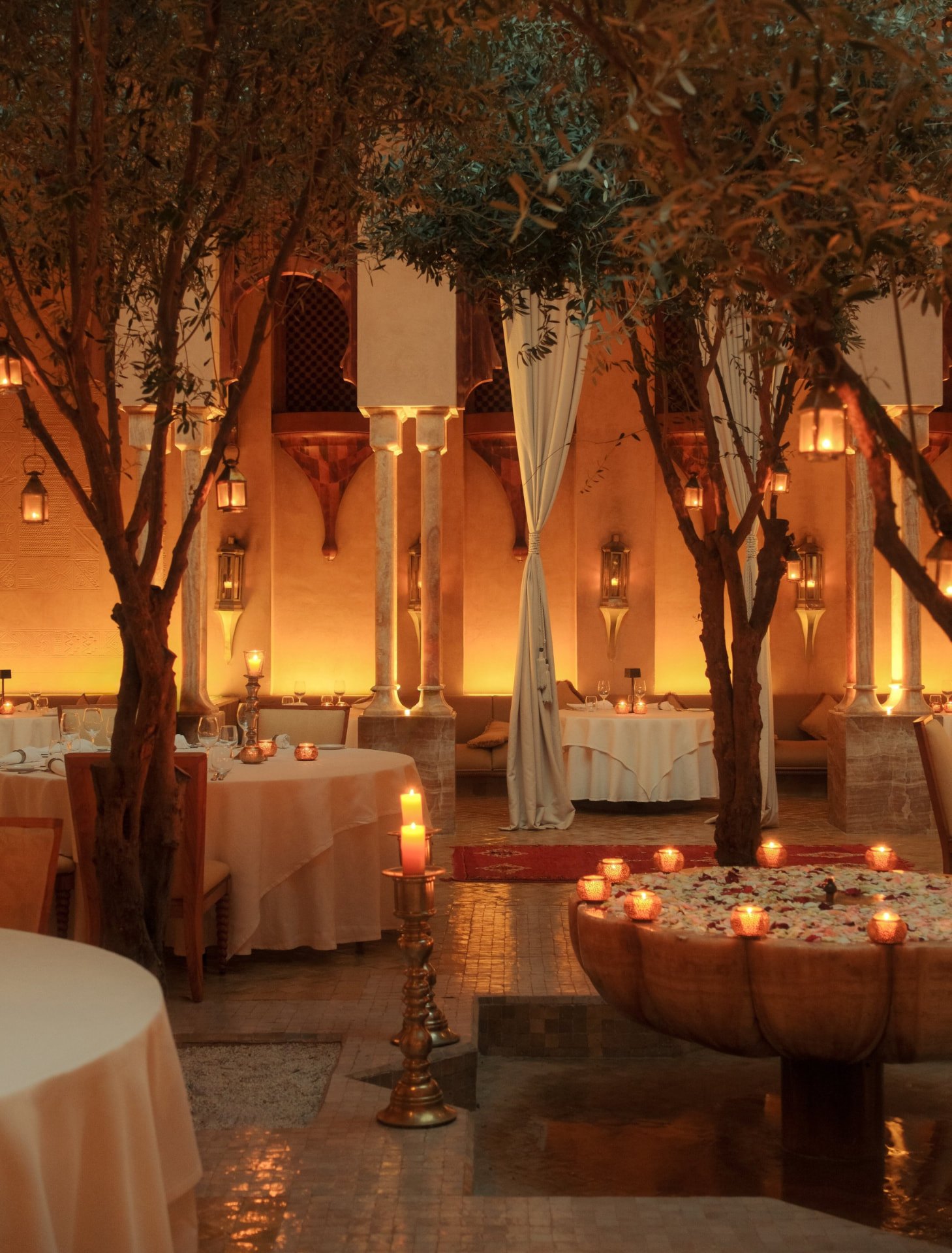
A candlelit table in a rose-walled Moroccan courtyard at dusk with a traditional tagine, mint tea poured from a silver pot, garden herbs and Moroccan pastries

Dining

Morocco, cooked slowly and eaten outside

Breakfast happens beside the water, early, while the light is still coming in flat across the grove. Msemen torn by hand. Amlou and honey. Oranges pressed a moment ago and dates from the south, cold and dense and better than any dessert. Coffee, then mint tea, poured from a height because that is how it is aerated, and the third glass is always the sweetest.

Lunch belongs to the garden — herbs and vegetables grown in the potager, grilled fish from the Atlantic three hours west, olive oil pressed from the trees you have been walking under. Mediterranean instinct runs through it, as it does everywhere along this coast, but the deep centre of the cooking is Moroccan: tagines built in the morning and left alone all afternoon, saffron, preserved lemon, ras el hanout ground by hand, lamb that has given up entirely by the time it reaches the table.

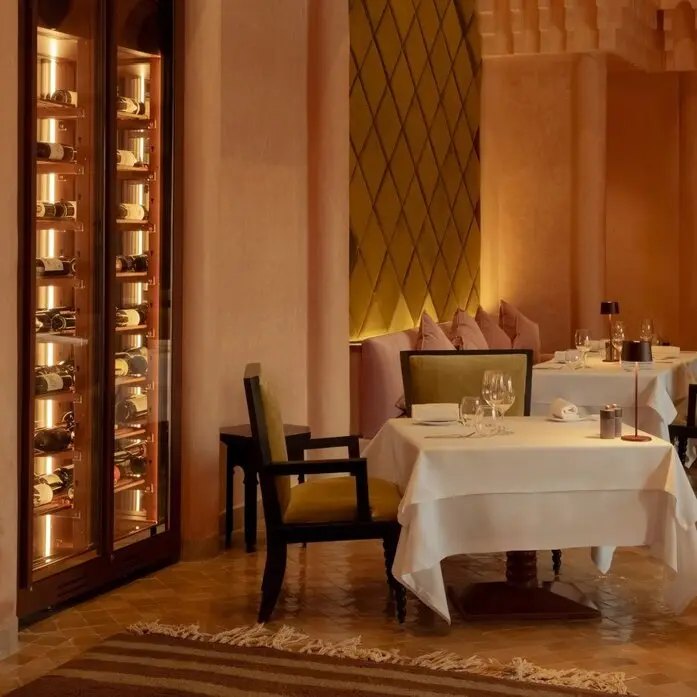
In the evening a table can be set in a private courtyard with lanterns and nothing else, or under the arcade with the bassin going black beside you. Pastilla, if you are lucky. Pastries with orange-flower water, almonds, sesame. Somewhere over the wall the last call to prayer travels out across the plain, and the correct response is to stop talking until it has finished.

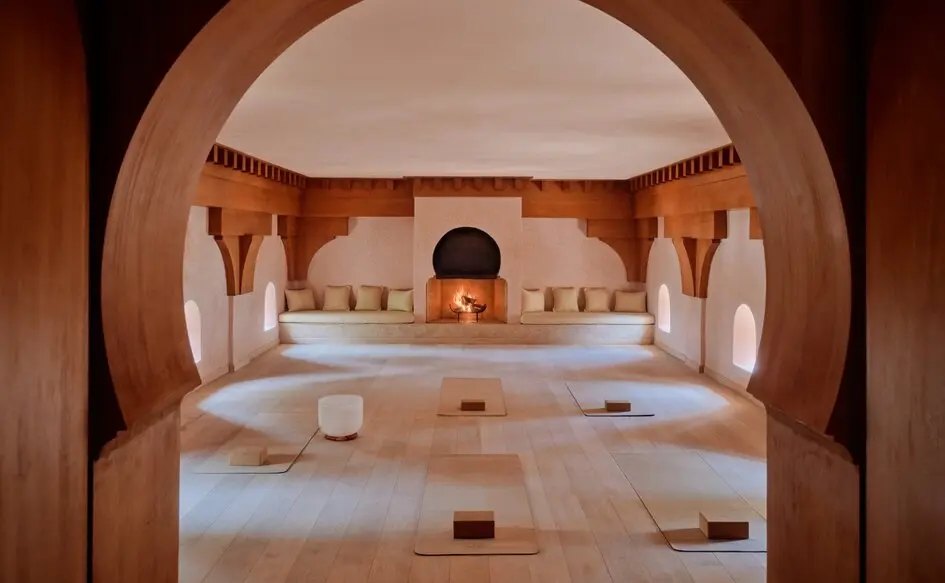
A traditional Moroccan hammam with warm tadelakt walls, a domed ceiling pierced by star-shaped skylights casting shafts of light through steam, brass bowl and argan oil

Wellness

Steam, black soap, and stars cut into a dome

The hammam is the oldest social ritual in this country and the spa here treats it as such. You go in and the room is warm and dim and the only light comes through star-shaped openings in the dome, arriving in solid shafts through the steam. Then time stops being a useful measurement. Savon noir, made from olives, left to work. The kessa glove, which is not gentle and is not meant to be. Ghassoul clay from the Atlas, cool on hot skin. Water poured from a brass bowl, repeatedly, without ceremony.

Afterwards, argan oil — pressed from a tree that grows nowhere else on earth, worked into the skin by hands that learned it from other hands — in a treatment pavilion with the shutters half closed and the garden audible outside. Massage here is unhurried to the point of seeming to have forgotten about you, which is exactly the intention.

There is yoga in the early morning under the olives, and meditation for anyone who wants it, and neither is compulsory. What actually restores people is more ordinary and harder to arrange elsewhere: several consecutive days in a place built entirely from shade and running water, in a climate that makes the middle of the day impossible, until doing nothing between two and five stops feeling like a failure and starts feeling like the local custom. Which it is.

Signature Experiences

Eight ways into Morocco

They belong to the city and the mountains rather than to the hotel, which is exactly why they matter. One a day is plenty. Some days none at all is better.

  • No. 01

    The Medina, walked with an art historian

    Not a tour. A long conversation held while moving, with somebody who can read a doorway the way other people read a sentence — why the plaster stops where it stops, which dynasty left that arch, what the tilework is counting. Go early, before the alleys fill, when the dyers are hanging wool and the light comes down in single shafts. You will see less than a guidebook promises and understand considerably more.

  • No. 02

    A balloon above the plain, before sunrise

    You leave in the dark. The burner is very loud and then it stops, and after that there is only wind, which you are travelling inside of and therefore cannot hear. Below, the Haouz plain turns from grey to rose. Villages wake. The Atlas takes the first light along its whole length at once. Nobody in the basket says very much.

  • No. 03

    Tea, poured by a Berber family

    In the foothills, in a room with a low table and a good deal of patience. The pot is lifted higher than seems necessary; the glass is filled, returned, filled again, three times, each one different. The ceremony is not performance — it is how time is offered here. Accept all three.

  • No. 04

    A day in the High Atlas

    An hour and a half from the palms and you are among walnut trees, terraces cut by hand into the slope, and villages the colour of the mountain they are made from. Walk a valley. Eat under a mulberry. Come back down through the late-afternoon dust with the whole plain laid out below you and Marrakech somewhere in it, small.

  • No. 05

    Majorelle, in the first hour

    The garden is a colour before it is a place — that particular blue, which Jacques Majorelle mixed and Yves Saint Laurent kept. Arrange to be there before the gates open properly. Bamboo, cactus, water, shade, and the sound of birds doing all the talking. Twenty quiet minutes there is worth two crowded hours.

  • No. 06

    Cooking, from the market backwards

    Begin where the food does: preserved lemons, saffron threads counted out, ras el hanout ground by somebody who will not tell you the whole recipe. Then the slow business of a tagine — the geometry of it, the way the cone returns the steam. What you learn is mostly about patience, and it travels home with you better than anything you could buy.

  • No. 07

    Dinner in the Agafay, under everything

    Forty minutes west the green stops and the land turns to pale stone hills, dry and lunar and entirely silent. A table, lanterns, a fire, and above it a sky nobody here has ruined. Between courses people stop talking for long stretches, which is unusual at dinner and tells you most of what you need to know.

  • No. 08

    An afternoon in the workshops

    Brass beaten thin, cedar carved without a drawing, zellige chipped tile by tile from a fired square — each cut made by eye, thousands of them, to build a pattern that cannot be sketched in advance. Sit down. Watch one man work for an hour. Afterwards you will look at every wall in Morocco differently.

Maison Voyage Loves

Six small things

  • Mint tea beneath the olive trees in the first hour, when the leaves are still turning over silver in the wind.
  • Sunlight moving across the surface of the bassin, and the way it throws water-light up onto the underside of an arch.
  • Orange blossom after sunset, which arrives suddenly, from nowhere in particular, and is gone again by morning.
  • Standing in a courtyard long enough to hear only the fountain, and then to stop hearing even that.
  • Cold dates after breakfast, eaten standing up, with the stones going into your other hand.
  • Walking the grove before the city has woken, when the earth is damp and the light has not decided on a colour.

Who This Place Is For

Travellers who want the city, and somewhere to put it down at the end of the day.

It suits people who look at buildings. Architects and designers do very well here, and so does anyone who has ever wanted to know how a wall is made out of earth. It suits gardeners, and readers, and cooks, and anyone drawn to Moroccan craft — the tile, the cedar, the brass, the weaving — who would like to spend a week close enough to the workshops to visit them properly. Couples find it romantic in a particular way, which has more to do with lantern-light on plaster than with anything arranged.

It rewards slow travellers above all: people who intend to go into the medina three times rather than once, take the mountains on a whole day rather than a morning, and leave the flat middle of the afternoon entirely undefended. Writers and photographers keep coming back, for reasons that become obvious around six in the evening. So do people who simply want to be private for a while.

And it will not suit everyone. If what you want is to step out of your door into the souks at midnight, stay in a riad inside the walls — the medina is a fifteen-minute drive away, which is a short distance and still a decision each time. If you want beach, this is not the coast. If you want nightlife, Marrakech has it and this place is deliberately turned away from it. Come here for the grove, the water and the light. Everything else is a drive.

Nearby Discoveries

Beyond the olive walls

Not a checklist. Eight things worth arranging your days around, and a great deal left deliberately undone.

  • No. 01

    Jardin Majorelle, and the museum beside it

    Go for the blue and stay for what sits next door: a museum of Yves Saint Laurent's working life built from Marrakech brick, where you can see exactly how a city's colours became a wardrobe. Early morning, always.

  • No. 02

    Ben Youssef Madrasa

    Six centuries of students, and a courtyard so exactly proportioned that people fall silent walking into it. Cedar, stucco, zellige, water. It is the clearest lesson in Moorish architecture available anywhere in Morocco, and it takes twenty minutes.

  • No. 03

    Bahia Palace, in the late afternoon

    A hundred and fifty rooms built to hold shade. Painted ceilings, courtyards opening into courtyards, orange trees. Come when the crowds thin and the light goes long across the tiles.

  • No. 04

    The souks, without a list

    The mistake is to arrive wanting something. Walk instead. Follow the sound of hammering to the metalworkers, the smell of cedar to the carpenters, the dye to the tanners. Get lost deliberately for an hour, then take mint tea somewhere with a view of the roofs.

  • No. 05

    Galleries and the new Marrakech

    Contemporary Moroccan photography and painting, shown in courtyard houses and old warehouses in the Ville Nouvelle and Sidi Ghanem. The country's own artists, arguing about it in the present tense.

  • No. 06

    Riads, for one afternoon

    Amanjena is olive groves and horizon; a riad is the opposite discipline — a house turned entirely inward, four walls and a pool of sky. Have lunch in one. Understanding both is understanding the city.

  • No. 07

    The Agafay, on the way to nowhere

    Stone desert, forty minutes out, with the Atlas along the whole eastern edge. No dunes, no camels arranged for photographs. Just pale hills, a great deal of wind and the loudest silence near the city.

  • No. 08

    Ourika and the Atlas villages

    Follow the river up into the mountains, where the air turns cold and the tagines are cooked over wood. A slow drive, several stops, and the reminder that Marrakech is a city built at the foot of something much older.

A Note from the Editor

Five nights. Two mornings in the medina. One day facing the mountains.

Come between October and April, when the plain is cool and the Atlas still carries snow along the whole horizon; avoid high summer unless you genuinely love heat. Go into the city early rather than late, and come back before the afternoon closes in. And on one evening, do not arrange anything at all — sit at the end of the bassin as the walls turn from rose to copper, and wait for the call to prayer to cross the olive grove from the direction of Marrakech. It lasts a few minutes. It is the reason to come.

Ben Trousil, Founding Editor

From the Journal

Continue reading

All stories
  • Rooftops of the Marrakech medina at dusk with terracotta walls, the Koutoubia minaret and the Atlas Mountains beyond

    CitiesAugust 2026

    48 Hours In Marrakech

    Two days arranged around light rather than sights — the medina before it wakes, the long flat afternoon, and the hour when the whole city turns the colour of its walls.

  • A cobalt blue Moroccan garden wall with cacti, bamboo and an ochre window frame in strong graphic shadow

    DesignJuly 2026

    The Colours Of Marrakech

    Rose, ochre, cobalt, saffron and the particular green of glazed tile. How one city's palette escaped its walls and went on to dress half the twentieth century.

  • A Moroccan artisan working brass by hand in a dim medina workshop lit by a shaft of daylight

    CraftJune 2026

    The Art Of Moroccan Architecture

    Zellige, tadelakt, carved cedar and the geometry beneath all of it — a slow look at the crafts that build a room out of proportion and shade rather than decoration.

Eine persönliche Anfrage

Let's Curate Your Moroccan Journey

If the olive grove has begun to sound like your next journey, we would be glad to arrange it personally — Marrakech, the mountains behind it and the long, slow days in between.

The medina walked with an art historian, a day in the High Atlas, a night under the stone hills of the Agafay, artisan workshops opened privately, exceptional tables both inside and outside the walls, and a stay shaped entirely around the way you actually travel.

Warum über Maison Voyage buchen?

  • Persönliche Luxusreiseberatung
  • Sorgfältig kuratierte Hotelempfehlungen
  • Maßgeschneiderte Reisepläne
  • Exklusive Partnervorteile, wo immer verfügbar
  • Persönlicher Ansprechpartner von Anfang bis Ende

Es entsteht keine Buchung und keine Kosten. Wir beginnen einfach ein Gespräch.

Eine Einladung

Die Reise fortsetzen

Ein Brief jeden Monat: ein Ort, den Umweg wert, ein Objekt, das Bewahren wert, eine Seite, langsam zu lesen wert. Nicht mehr.